Imagine someone you love suddenly collapses in front of you. They are not moving. They are not breathing. In that moment, knowing how to perform CPR could mean the difference between life and death, and you don't need a medical degree to help.
CPR (cardiopulmonary resuscitation) is one of the most powerful things any person can learn. And this guide will walk you through exactly what it is, how it works, and how you can use it to give someone a second chance at life.
At Sanitas Medical Centers, we believe that informed families build safer, healthier communities. So let's get started.
What is CPR, and why does it matter?
CPR stands for cardiopulmonary resuscitation. That's a long word, but the idea behind it is simple: when someone's heart stops beating, CPR uses chest compressions, and sometimes rescue breaths, to keep blood moving through the body until professional help arrives.
Think of it like this. Your heart is a pump. Every beat pushes blood through your body, carrying oxygen to your brain, your organs, and every cell that keeps you alive. When the heart stops, that oxygen delivery stops too. And the brain, which needs oxygen more than almost any other part of the body, can start to suffer damage in as little as four to six minutes.
That is not a lot of time.
When you call 911, the average emergency response time in the United States is somewhere between seven and ten minutes, depending on where you live. That gap, between the moment someone's heart stops and the moment paramedics walk through the door, is where CPR makes all the difference.
Bystander CPR can double or even triple a person's chance of survival. Yet studies have shown that CPR is performed by a bystander in fewer than half of all out-of-hospital cardiac arrest cases. Often, the only reason someone did not step in was because they were afraid of doing it wrong.
We want to change that.
Who can have a cardiac arrest?
One of the most important things to understand is that cardiac arrest is not just something that happens to elderly people or those with known heart problems. It can happen to anyone, anywhere, at any time.
Cardiac arrest, when the heart suddenly stops beating, is different from a heart attack, though it can sometimes be triggered by one. A heart attack happens when blood flow to part of the heart muscle is blocked. A cardiac arrest happens when the heart's electrical system malfunctions and the heart stops pumping entirely.
Some people who experience cardiac arrest:
- Feel no warning signs whatsoever
- Are in the middle of exercising or playing sports
- Are otherwise healthy adults, teenagers, or even children
- Collapse suddenly without any prior diagnosis
\This is exactly why CPR knowledge is so valuable for everyone, not just healthcare workers or parents of young children, but neighbors, coworkers, friends, and community members of all ages.
Recognizing a cardiac arrest: what to look for
Before you can help someone, you need to recognize that they need help. Here are the signs that someone may be in cardiac arrest:
- They collapse suddenly. The person may be walking, talking, or going about their day, and then they simply fall.
- They are unresponsive. When you tap them on the shoulder and call out to them, they do not react.
- They are not breathing normally. They may not be breathing at all, or they may be making slow, gasping sounds called agonal breathing. This is not normal breathing. It is a sign the body is in serious trouble.
- Their skin may change color. Some people's lips or fingertips may look blue or grayish as oxygen levels drop.
If you see these signs, the time to act is right now.
The 3 golden steps: check, call, act
Whether you have had any formal training or not, there is a simple three-step framework that applies to almost every emergency situation. Remembering these three words: Check, Call, Act, can help you stay focused even when your heart is pounding and your hands are shaking.
Step 1: check
Before you rush toward the person, take a quick look at your surroundings. Is there anything nearby that could put you in danger? A gas leak, traffic, live wires, or an unstable structure are all reasons to stay back and call for help from a safe distance.
If the environment seems safe, move toward the person. Kneel down beside them and give their shoulders a firm tap. Lean in and speak loudly: "Are you okay? Can you hear me?"
Look at their chest. Is it rising and falling? Lean your ear toward their mouth and nose. Do you hear any sound of breathing?
If there is no response and no normal breathing, move immediately to step two.
Step 2: call
Call 911 right away, or have someone else do it while you prepare to begin CPR.
If there are other people nearby, do not just shout "someone call 911!" Research on emergency situations has shown that this kind of general call often goes unanswered because people assume someone else is already handling it.
While you are at it, send someone to look for an AED (automated external defibrillator). These devices are found in many public spaces: airports, gyms, shopping centers, schools, and office buildings. They are designed to be used by non-medical people and can restore a normal heart rhythm. We will talk more about AEDs in a moment.
Step 3: act
This is where you begin CPR. Do not wait for the paramedics to arrive. Do not wait until someone with more experience shows up. Start now.
How to perform hands-only CPR: a step-by-step guide
The American Heart Association recommends hands-only CPR for untrained bystanders, and research confirms it is highly effective. Unless you have been formally trained in CPR with rescue breaths and feel confident doing so, focus entirely on chest compressions. They are the most important part.
Here is exactly what to do:
- Position the person correctly
Make sure the person is lying flat on their back on a firm surface. If they are on a bed or couch, move them to the floor. A soft surface will absorb the force of your compressions and make them far less effective. - Get yourself into position
Kneel down beside the person, close to their chest. You want to be in a stable position where you can use your body weight, not just your arms, to push down. - Place your hands
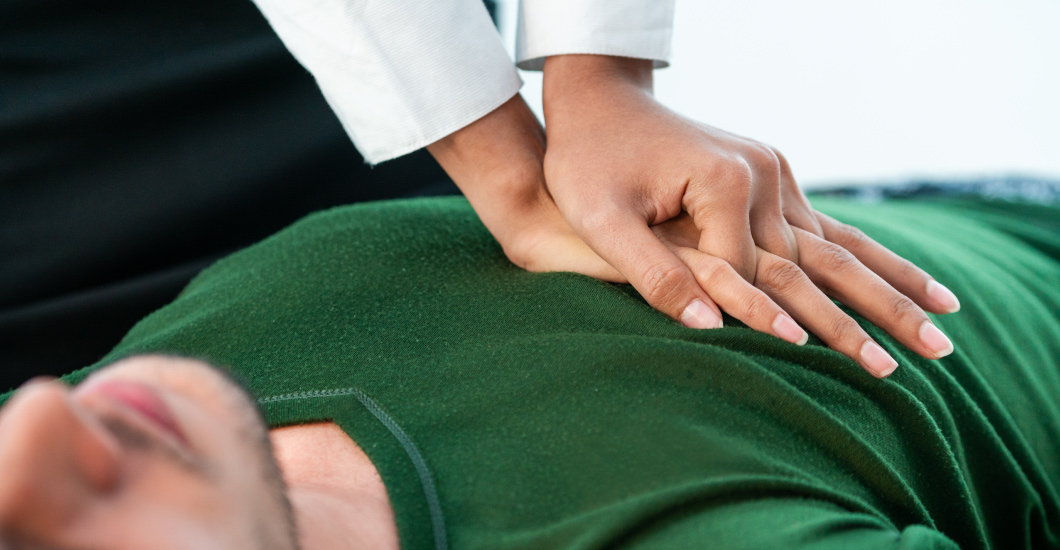
Find the center of the person's chest. This is the lower half of the breastbone, right between the nipples. Place the heel of one hand (the firm, bony base of your palm) flat against this spot. Then place your other hand on top of the first and interlace your fingers, keeping your fingers lifted so that only the heel of your bottom hand is pressing on the chest. - Push hard
With your arms straight and elbows locked, lean forward and use your body weight to push straight down on the chest. You need to compress the chest by about 2 inches (5 centimeters). That may feel like a lot, and it should. Effective compressions are firm. You may feel or hear a pop, and that is okay. In an emergency, a broken rib is far less serious than an untreated cardiac arrest. - Push fast
The target rate is 100 to 120 compressions per minute. An easy way to remember it: hum the beat of "Stayin' Alive" by the Bee Gees, which matches the ideal CPR rhythm almost perfectly. Other songs with a similar tempo include "Crazy in Love" by Beyoncé and "September" by Earth, Wind & Fire. - Allow full recoil
After each compression, let the chest rise completely back to its normal position before pushing down again. This recoil allows the heart to refill with blood between compressions. Keep your hands in contact with the chest, but release the pressure fully. - Keep going
Do not stop. Compressions are physically demanding, and you may feel tired very quickly, especially in the first few minutes. If there is another person nearby who knows CPR or is willing to try, you can switch off every two minutes to keep the compressions strong.
What about mouth-to-mouth breathing?
For bystanders in an emergency, hands-only CPR is just as effective in the first few minutes following cardiac arrest. When someone's heart first stops, there is still oxygen in the bloodstream, and compressions keep it moving to the brain.
If you are trained in rescue breaths and feel comfortable, give 2 rescue breaths after every 30 compressions. But if you are unsure: keep your hands on the chest and keep pushing. That is the most important thing you can do.
Overcoming the fear of doing it wrong
If you feel hesitant about performing CPR, you are not alone. Surveys have found that fear of injury, fear of doing it incorrectly, and even fear of legal consequences are among the most common reasons people hold back in cardiac arrest situations.
Let's address those fears directly.
Can I hurt the person? In very rare cases, CPR can cause rib fractures or bruising. But here is the reality: someone in cardiac arrest is already in a life-threatening situation. A bruised rib is treatable. Brain damage from oxygen deprivation is not always reversible. The possible harm of trying is far smaller than the certain harm of doing nothing.
What if I do it wrong? Even imperfect CPR is better than no CPR. Studies have repeatedly shown that bystander CPR, even when performed by people with no formal training, significantly improves outcomes compared to waiting for professionals. You do not need to be perfect. You need to be willing.
Am I legally protected? In the United States, every state has some version of a Good Samaritan law that protects bystanders who act in good faith during an emergency. These laws are specifically designed to encourage people to help without fear of being sued for unintentional harm.
The bottom line: your presence and your action matter, even when they are not perfect.
When to stop CPR
Performing CPR is exhausting, and it can be difficult to know when it is appropriate to stop. Here are the three main situations where it is acceptable to stop compressions:
- The person shows signs of life. If they begin to breathe normally, move purposefully, or open their eyes, stop compressions and monitor them until help arrives.
- Professional help takes over. When paramedics or other trained emergency responders arrive, they will take control of the situation. Step back and let them work.
- You are physically unable to continue. If you have been performing CPR alone and you are truly exhausted, it is better to stop than to continue with compressions too shallow to be effective. If possible, look for someone who can relieve you before you reach that point.
Special situations: what you should know
For children (ages 1–8): Use one hand instead of two, and push down about one-third the depth of the chest. For infants under 1 year, use two fingers and be much gentler. If you care for young children regularly, a formal pediatric CPR course is well worth your time.
After water rescue: Lay the person on a firm surface and check for responsiveness and breathing before starting CPR. Water in the lungs does not stop CPR from working.
If you are worried about illness: Hands-only CPR requires no mouth-to-mouth contact. A CPR face shield in your first aid kit adds an extra layer of protection if you do give rescue breaths.
More than a skill: an act of love
There is something deeply human about CPR. It is the act of placing your hands on another person's chest and saying, with your body and your effort: I am not giving up on you.
It does not require special equipment. It does not require a uniform or a title. It requires only the knowledge of what to do and the courage to do it.
CPR knowledge means that in the worst moment of someone's life, you have the power to act. Not to replace the doctors or the paramedics, but to fill the gap between the moment a heart stops and the moment professional help arrives. That gap is where lives are saved or lost.
You do not need to be perfect. You just need to be willing.
Because sometimes, the most powerful thing you can offer someone is another chance to live.
Take the next step: book your appointment at Sanitas Medical Center
Learning CPR is a powerful first step toward protecting the people you love. At Sanitas Medical Center, we're here to support your health journey with preventive care, heart health guidance, and a team that puts your well-being first.
Don't wait for an emergency to prioritize your health. Book your appointment today and take the next step toward a healthier future.