Breathing is life — But are you doing it right?
You breathe about 20,000 times every single day. Most of those breaths happen without you thinking about it. Your body just does it, on autopilot. But here's something surprising: the way you breathe has a huge effect on how you feel, physically and mentally.
Most of us breathe too fast and too shallow. We pull air into our chests, barely filling our lungs. We breathe quickly when we're stressed, and we never slow down long enough to let our bodies truly relax. Over time, this kind of breathing keeps our bodies stuck in a low-level stress response, even when we don't realize it.
Now for the good news: you can change this. And when you do, the results can be remarkable.
Breathing exercises for health and wellness are one of the most powerful and most overlooked tools available to anyone. They cost nothing. They require no equipment. You can do them anywhere. And science shows they can affect everything from your heart rate to your sleep to your emotional balance.
This guide will walk you through everything you need to know: why breathing matters so much, what the best breathing exercises are, and how to build a simple daily habit that can genuinely transform your health.
Why your breath is more powerful than you think
Breathing is often thought of as just a way to get oxygen into your body. And yes, oxygen is essential. But your breath does so much more than that.
Your breathing pattern is directly connected to your nervous system. When you breathe fast and shallow, your body reads that as a signal of danger. Your heart speeds up. Your muscles tense. Stress hormones like cortisol and adrenaline flood your bloodstream. This is your "fight or flight" response, a survival system built for emergencies.
The problem is that many of us live in this stressed state much of the time, even when there's no real danger. Busy schedules, bad news, work pressure, and everyday worries keep our nervous systems on high alert. Our breathing reflects that — and makes it worse.
But here's what's amazing: you can reverse this process simply by changing how you breathe.
Slow, deep, intentional breathing sends a different signal to your brain. It says: We are safe. We can relax. Your body responds by:
- Lowering your heart rate and blood pressure
- Reducing levels of stress hormones
- Calming anxiety and emotional tension
- Improving the quality of your sleep
- Boosting your physical performance and endurance
- Supporting your immune system and overall health
Your breath is the fastest way to calm your nervous system — no pills, no appointments, no cost. It's always with you. It's always available. And once you learn to use it well, it becomes one of your greatest health tools.
The three principles behind wellness breathing
Before we get into the specific exercises, it helps to understand what makes a breathing practice actually work. Wellness breathing is built on three core principles:
- Simplicity: Breathing exercises are easy to learn and safe for almost everyone. You don't need any prior experience, special training, or fancy equipment. If you can breathe — and you can — you can do these exercises.
- Consistency: A few minutes of intentional breathing every day is far more effective than one long session once in a while. Just like brushing your teeth or taking a short walk, the real benefits come from making it a regular habit. Five to ten minutes a day is all it takes to start feeling a difference.
- Awareness: This is perhaps the most important principle. Breathing with intention — meaning, paying attention to your breath as you do it — changes how your brain processes stress and emotion. Mindful breathing rewires your nervous system over time. It builds your capacity to stay calm under pressure, sleep more deeply, and feel more in control of your mental state.
When you combine simplicity, consistency, and awareness, you have a wellness practice that is both powerful and sustainable.
Three breathing exercises that can change your health
Here are three of the most effective breathing exercises for overall well-being. Each one serves a different purpose, energizing, calming, or stress relief — so you can choose the right one for the right moment.
Exercise 1: Energizing morning breathing
Best for: Waking up your body and mind naturally
Most of us reach for coffee first thing in the morning. But before you brew that cup, try giving your body a natural energy boost through your breath. This exercise is designed to increase alertness and get your blood flowing — without caffeine.
How to do it:
- Stand or sit comfortably, with your back straight.
- Take a deep inhale through your nose, filling your lungs fully.
- Exhale briefly and actively — a short, sharp breath out through your mouth or nose.
- Continue this pattern rhythmically for 30 to 60 seconds.
- The key is the rhythm: breathe in slowly and deeply, then breathe out quickly and with a little force.
When to do it: In the morning, for 5 to 10 minutes.
What it does for you:
- Increases alertness and mental clarity — great before work, school, or any demanding task
- Improves circulation by getting your blood moving faster
- Naturally boosts energy — a healthy alternative to relying on caffeine
- Clears away mental fog that often lingers in the morning
Think of it this way: each inhale brings in fresh energy, and each exhale releases the tiredness of sleep. Inhale energy. Exhale fatigue. After just a minute or two, you'll notice the difference.
Tip: Pair this with a glass of water right after waking up, and you've already done two great things for your body before the day even starts.
Exercise 2: Diaphragmatic (belly) breathing
Best for: Deep calm, stress relief, and everyday wellness
This is the foundation of healthy breathing. Diaphragmatic breathing — also called belly breathing or abdominal breathing — is the way humans are naturally designed to breathe. Most of us have drifted away from it over time, replacing deep belly breaths with shallow chest breaths. This exercise helps you return to your body's natural rhythm.
The diaphragm is a large dome-shaped muscle that sits beneath your lungs. When it works properly, your belly rises as you breathe in — not just your chest. This type of breathing fully inflates your lungs, brings in more oxygen, and activates your body's natural relaxation response.
How to do it:
- Sit in a comfortable chair or lie down on your back.
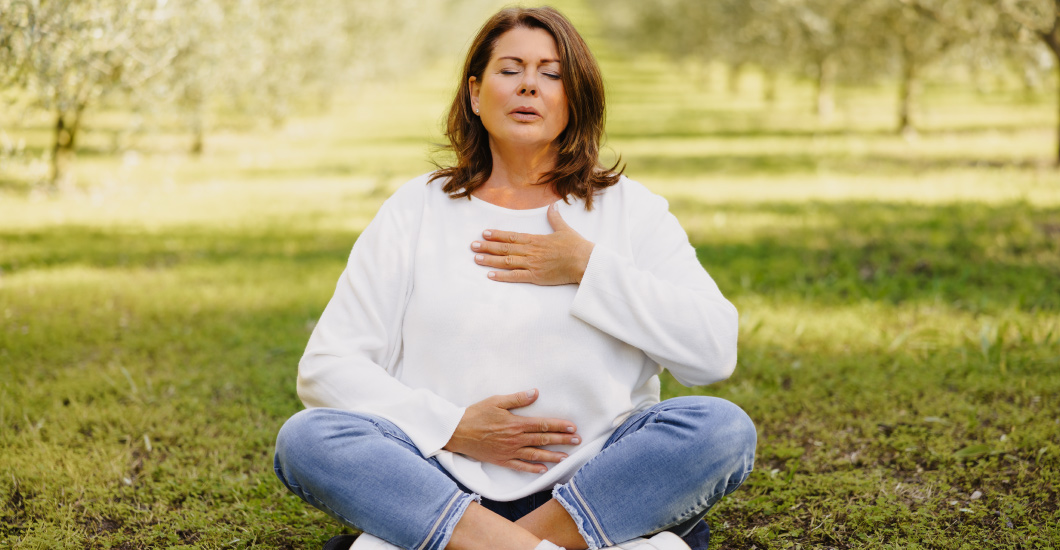
- Place one hand on your chest and the other hand on your belly, just below your ribs.
- Inhale slowly through your nose for about 4 seconds. As you breathe in, your belly should rise and push your hand outward. Your chest should stay mostly still.
- Exhale gently through your mouth for about 4 to 6 seconds. Feel your belly fall as the air leaves your lungs.
- Repeat for 5 to 10 minutes.
When to do it: This exercise is ideal before bed, during stressful moments, or any time you feel tension building in your body. It also works well as a midday reset.
What it does for you:
- Reduces stress and anxiety by activating the parasympathetic nervous system (the body's "rest and digest" mode)
- Lowers heart rate and blood pressure, helpful for people managing hypertension
- Improves the supply of oxygen throughout your body
- Relieves physical tension in the chest, shoulders, and neck
- Helps you fall asleep faster when practiced before bed
The hand placement is key — it gives you feedback so you can feel whether you're breathing into your belly or just your chest. Once you get the hang of it, it becomes second nature.
Exercise 3: 4-6 relaxation breathing
Best for: Stress relief, emotional balance, and winding down at night
If you've ever been told to "take a deep breath" when you're stressed, this is why: longer, slower breaths signal safety to your nervous system. The 4-6 breathing method is one of the most research-supported breathing techniques for reducing anxiety and stress quickly.
The key to this exercise is that your exhale is longer than your inhale. When you breathe out for longer than you breathe in, you activate the vagus nerve — a major pathway of the parasympathetic nervous system. This triggers a calming cascade throughout your body: your heart rate slows, your blood pressure drops, your muscles relax.
How to do it:
- Sit or lie in a comfortable position. Close your eyes if possible.
- Inhale through your nose for 4 seconds — steady and smooth.
- Exhale through your mouth for 6 seconds — slow and controlled, like you're gently blowing out a candle.
- There's no need to hold your breath between inhales and exhales — just keep the rhythm going naturally.
- Repeat for 3 to 5 minutes.
When to do it: This works especially well at night before sleep, or during stressful situations — a difficult conversation, a busy afternoon, a moment of anxiety or overwhelm.
What it does for you:
- Activates the parasympathetic nervous system — the part of your nervous system responsible for calming you down
- Reduces the physical symptoms of stress — racing heart, tight chest, shallow breathing
- Improves emotional regulation — helps you respond to challenges more calmly
- Prepares your body and mind for deep, restful sleep
- Lowers anxiety levels within minutes of starting
There's something almost poetic about this exercise. Every long exhale is your body's way of saying: You are safe. You can let go. The more you practice, the more your nervous system learns to return to calm quickly, even in difficult moments.
How often should you practice?
Here's the best part: you don't need to carve out a big chunk of time to make this work.
5 to 10 minutes a day is all it takes to start seeing real benefits. That's less time than most people spend scrolling through their phones in the morning.
Here are some easy ways to fit breathing exercises into your daily routine
- Morning: Start with Energizing Morning Breathing to wake up your body and mind naturally.
- Midday: Use 4-6 Relaxation Breathing for 3 minutes during a work break to reset and recharge.
- Evening: Wind down with Diaphragmatic Breathing before bed to help your body shift into sleep mode.
- Stressful moments: Any of these exercises can be used in real time during tense situations — before a big meeting, after an argument, or during a moment of anxiety.
You can practice these exercises anywhere:
- At home, in a comfortable chair or lying in bed
- At work, during a short break or before a meeting
- In your parked car, before heading inside
- Even in a waiting room or quiet corner of a busy day
No mat. No app. No gym membership. Just you and your breath.
Consistency is what leads to transformation.
You don't need to be perfect. You just need to show up — day after day, breath after breath. Over time, you'll notice that stress hits differently. Sleep comes more easily. You feel more grounded. More in control. More like yourself.
The science behind the benefits
You might be wondering: does this actually work, or is it just a wellness trend? The evidence is solid.
Decades of research have shown that intentional breathing practices have measurable effects on the body and brain. Studies have found that regular deep breathing can:
- Lower blood pressure in people with hypertension — sometimes significantly
- Reduce levels of cortisol, the primary stress hormone
- Improve heart rate variability (HRV), a key marker of cardiovascular health and resilience
- Decrease symptoms of anxiety and depression over time
- Improve sleep quality in people with insomnia
- Enhance athletic performance by improving oxygen efficiency
- Support immune function by reducing the chronic stress that weakens immunity
These aren't small or marginal effects. For many people, a consistent breathing practice can genuinely shift the trajectory of their health, without side effects, without cost, and without complexity.
Building a breathing habit that sticks
Starting a new habit is easy. Sticking with it is the real challenge. Here are a few strategies to help you make breathing exercises a lasting part of your routine:
- Start small. Don't try to do 20 minutes on day one. Start with 3 to 5 minutes and build from there. Small wins create momentum.
- Attach it to something you already do. Practice belly breathing right after you brush your teeth at night. Do morning breathing right before you make coffee. Linking a new habit to an existing one makes it much easier to remember.
- Be kind to yourself. Some days you'll forget. Some days it won't feel like it's working. That's okay. The practice isn't about being perfect — it's about coming back.
- Notice how you feel. After a week of daily practice, check in with yourself. Are you sleeping better? Feeling less tense? Handling stress more smoothly? Recognizing progress, even small progress, keeps you motivated.
- Remember: your breath is always there. No matter where you are or what's happening, your breath is with you. It's the most available health tool you will ever have.
Whole-person care at Sanitas Medical Center
At Sanitas Medical Center, we believe that health is more than the absence of illness. True wellness means caring for your whole person — your body, your mind, and your emotional well-being.
That's why we offer the Sanitas BeWell program, designed to bring mental and behavioral health professionals directly into your primary care experience. Whether you're managing chronic stress, anxiety, sleep problems, or simply want support in building healthier habits like the breathing exercises in this article, the BeWell team is here for you.
You don't have to navigate your health alone. Call 1-844-665-4827 to book a Sanitas BeWell appointment or visit your nearest Sanitas Medical Center to speak with our care team. We're here to help you breathe easier — in every sense of the word.
Breathe more deeply. Live better.